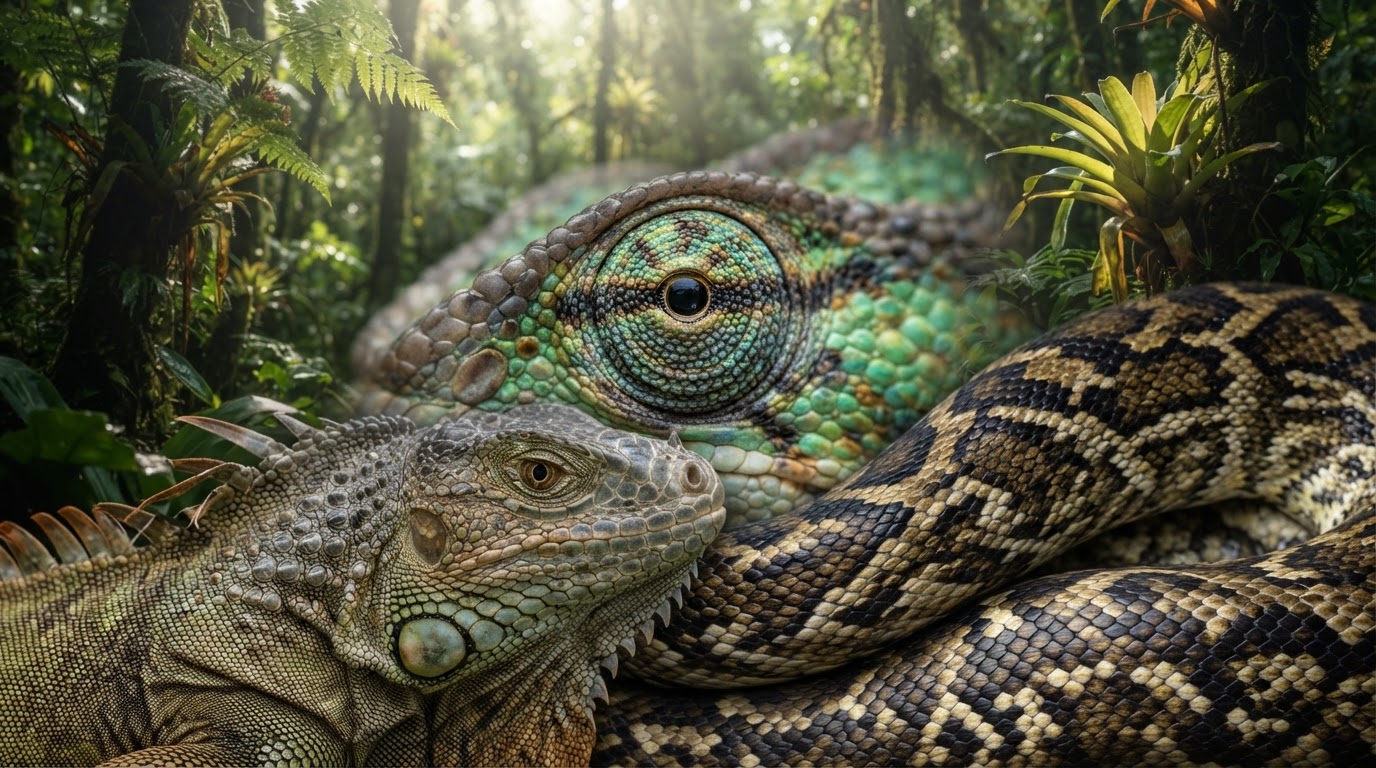
What Exactly Is a Reptile?
Reptiles are a class of cold-blooded vertebrates that have roamed our planet for over 300 million years. Belonging to the class Reptilia, these remarkable animals are characterized by their scaly skin, amniotic eggs, and ectothermic metabolism — meaning they rely on external heat sources to regulate their body temperature.
Unlike mammals, reptiles cannot generate their own body heat internally. Instead, they've evolved sophisticated behavioral strategies for thermoregulation: basking in sunlight to warm up, seeking shade or burrowing underground to cool down, and adjusting their activity patterns to match environmental conditions. This fundamental characteristic shapes every aspect of their biology, behavior, and care requirements.
The Four Orders of Living Reptiles
Modern reptiles are divided into four distinct orders, each with unique characteristics that set them apart:
Squamata: Lizards and Snakes
The largest order of reptiles, Squamata encompasses over 10,000 species of lizards and snakes. Lizards typically possess external ear openings, movable eyelids, and four legs — though some species like glass lizards have evolved to be legless. Snakes, on the other hand, lack legs entirely and have evolved elongated bodies with hundreds of vertebrae, allowing them extraordinary flexibility and unique methods of locomotion.
Popular pet species in this order include bearded dragons, leopard geckos, ball pythons, and corn snakes — all of which have been selectively bred in captivity for decades, producing a stunning variety of color morphs and patterns.
Testudines: Turtles and Tortoises
With their iconic protective shells, turtles and tortoises represent one of the most recognizable groups of reptiles. Their shells are actually modified rib cages fused with their spine, creating a bony armor covered in keratin scutes. Turtles are generally aquatic or semi-aquatic, while tortoises are exclusively land-dwelling herbivores.
Some tortoise species can live well over 100 years, making them among the longest-lived vertebrates on Earth. The Aldabra giant tortoise and Galápagos tortoise are famous examples of this remarkable longevity.
Crocodilia: Crocodilians
Crocodilians include crocodiles, alligators, caimans, and gharials. These large, semi-aquatic predators are the closest living relatives of birds and dinosaurs. They possess powerful jaws, armored skin, and a four-chambered heart — unique among reptiles. While not typically kept as pets due to their size and dangerous nature, they play crucial ecological roles as apex predators in tropical and subtropical freshwater ecosystems.
Rhynchocephalia: Tuatara
The tuatara of New Zealand is the sole surviving member of this ancient order. Often called a "living fossil," the tuatara has remained virtually unchanged for over 200 million years. It possesses a unique "third eye" on top of its head — a photoreceptive organ covered by scales that helps regulate circadian rhythms and seasonal behaviors.
How Reptiles Regulate Body Temperature
Thermoregulation is perhaps the most important concept to understand about reptiles, especially for those interested in keeping them as pets. As ectotherms, reptiles depend entirely on their environment for heat.
In the wild, reptiles employ several strategies:
- Basking — Positioning themselves in direct sunlight to absorb radiant heat through their scales
- Shuttling — Moving between warm and cool areas to maintain an optimal body temperature
- Burrowing — Retreating underground where temperatures remain more stable
- Color change — Some species can darken their skin to absorb more heat or lighten it to reflect heat
- Postural adjustments — Flattening their bodies to maximize surface area exposed to heat sources
For captive reptiles, this means providing a proper thermal gradient within their enclosure — a warm basking spot at one end and a cooler retreat at the other. This allows the animal to self-regulate its temperature just as it would in nature.
The Remarkable Skin of Reptiles
Reptile skin is fundamentally different from that of mammals or amphibians. It's covered in scales made of keratin — the same protein that forms human fingernails and hair. These scales serve multiple purposes:
Protection: Scales create a tough, armor-like barrier against predators, parasites, and environmental hazards. Some species, like armadillo lizards, have evolved particularly robust scales for defense.
Water retention: Unlike the permeable skin of amphibians, reptile scales create a nearly waterproof barrier that prevents dehydration. This adaptation was crucial in allowing reptiles to colonize arid environments far from water.
Shedding (Ecdysis): Reptiles periodically shed their skin as they grow. Snakes typically shed their entire skin in one piece, while lizards shed in patches. Healthy shedding is an important indicator of proper husbandry — incomplete sheds can signal inadequate humidity or underlying health issues.
Reptile Habitats Around the World
Reptiles have colonized nearly every habitat on Earth, from scorching deserts to tropical rainforests, from mountain peaks to ocean depths. Their adaptability is truly remarkable:
Deserts: Many lizard and snake species thrive in arid environments. The thorny devil of Australia, for instance, can collect water from morning dew through its specialized skin and channel it directly to its mouth.
Tropical Forests: Rainforests host the greatest diversity of reptile species. Chameleons, tree boas, and countless gecko species have evolved to exploit the vertical complexity of forest canopies.
Aquatic Environments: Sea turtles traverse entire oceans, marine iguanas dive to feed on algae, and saltwater crocodiles patrol coastal waters across Southeast Asia and Australia.
Temperate Regions: Even in cooler climates, species like the common European adder and the eastern box turtle have adapted through hibernation (brumation) strategies that allow them to survive freezing winters.
Reproduction in Reptiles
Reptile reproduction varies significantly across species, but most share the characteristic of producing amniotic eggs — eggs with a protective membrane that retains moisture, allowing them to be laid on land rather than in water.
Oviparous species lay eggs that develop and hatch outside the mother's body. Most turtles, crocodilians, and many lizards and snakes fall into this category. Some species exhibit temperature-dependent sex determination, where the incubation temperature determines whether offspring develop as male or female.
Viviparous species give live birth. Several snake species, including boas and garter snakes, retain eggs internally and deliver fully formed young. This strategy is particularly common in species living in cooler climates where external egg incubation might fail.
Parthenogenesis — reproduction without fertilization — occurs in some lizard species. Certain whiptail lizards consist entirely of females that produce genetically identical offspring, a fascinating adaptation for colonizing new environments.
Why Reptiles Matter
Beyond their intrinsic value as living organisms, reptiles play critical ecological roles:
- Pest control: Snakes and lizards consume vast numbers of rodents and insects, providing natural pest management that benefits agriculture and human health
- Seed dispersal: Tortoises and large lizards help distribute seeds across landscapes, supporting plant diversity
- Indicator species: Reptile populations often reflect the health of their ecosystems, making them valuable for environmental monitoring
- Medical research: Compounds from reptile venom have led to breakthrough medications, including drugs for high blood pressure and diabetes
Understanding reptiles — their biology, their needs, and their ecological importance — is the foundation for responsible ownership and effective conservation. Whether you're considering your first pet reptile or simply curious about these ancient creatures, this knowledge will deepen your appreciation for one of nature's most successful groups of animals.
Frequently Asked Questions
What are the main types of reptiles?
Living reptiles are divided into four orders: Squamata (lizards and snakes, the largest group with over 10,000 species), Testudines (turtles and tortoises), Crocodilia (crocodiles, alligators, and caimans), and Rhynchocephalia (the tuatara of New Zealand).
How do reptiles regulate their body temperature?
Reptiles are ectothermic (cold-blooded), meaning they rely on external heat sources. They regulate temperature through basking in sunlight, shuttling between warm and cool areas, burrowing underground, changing skin color, and adjusting body posture to maximize or minimize heat absorption.
What habitats do reptiles live in?
Reptiles inhabit nearly every environment on Earth — deserts, tropical rainforests, temperate woodlands, aquatic environments including oceans, and even mountain regions. Their adaptability has allowed them to colonize diverse ecosystems across all continents except Antarctica.
Are reptiles warm-blooded or cold-blooded?
Reptiles are cold-blooded (ectothermic). Unlike mammals, they cannot generate internal body heat and must rely on environmental heat sources to regulate their body temperature. This is why proper heating is so critical in captive reptile care.
How do reptiles reproduce?
Most reptiles are oviparous (egg-laying), producing amniotic eggs with protective membranes. Some species are viviparous (live-bearing), and a few species can reproduce through parthenogenesis — producing offspring without fertilization. Some species exhibit temperature-dependent sex determination in their eggs.