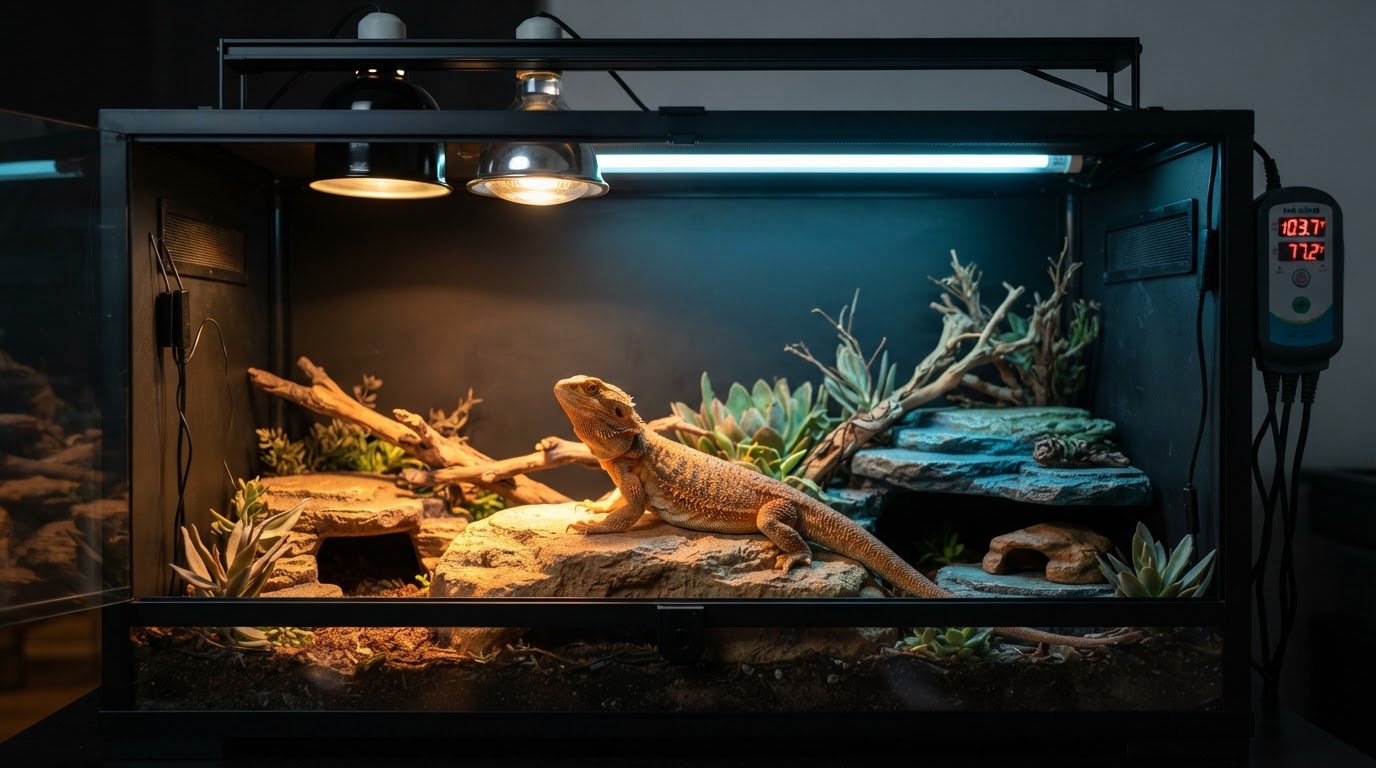
Why Heating and Lighting Are Non-Negotiable
If there's one aspect of reptile care that separates thriving animals from struggling ones, it's the quality of their heating and lighting setup. Reptiles are ectotherms — every metabolic process in their bodies, from digestion to immune function, depends on achieving and maintaining proper body temperatures through external heat sources.
A reptile kept at incorrect temperatures isn't just uncomfortable — it's slowly deteriorating. Food sits undigested in the stomach, the immune system falters, growth stalls, and behavior becomes lethargic. Conversely, a reptile with access to the right thermal gradient and appropriate UVB radiation will display vibrant colors, strong appetite, active behavior, and robust health.
Understanding the Thermal Gradient
The thermal gradient is the most fundamental concept in reptile heating. Rather than heating the entire enclosure to a single temperature, you create a spectrum of temperatures from one end to the other. This allows your reptile to thermoregulate — moving to warmer areas when it needs to raise its body temperature and retreating to cooler zones when it needs to cool down.
The Three Temperature Zones
Basking Zone: The hottest area, directly under or near the primary heat source. This is where your reptile comes to raise its body temperature to the species-specific preferred optimum temperature (POT). For bearded dragons, this is 100-110°F. For ball pythons, it's 88-92°F.
Warm Ambient Zone: The area surrounding the basking spot, typically 5-10°F cooler. Your reptile will spend much of its active time here once it has reached its POT.
Cool Zone: The opposite end of the enclosure from the basking spot. This provides a comfortable retreat and should be 15-25°F cooler than the basking zone. For most species, 72-78°F is appropriate.
Types of Heat Sources
Not all heat sources are created equal. Each type produces different wavelengths of energy and serves different purposes.
Halogen Basking Lamps
Halogen flood lamps are widely regarded as the best basking heat source. They produce a broad spectrum of infrared radiation (IR-A and IR-B) that penetrates deep into the reptile's tissue, warming them from the inside out — much like natural sunlight. This deep-penetrating heat is more effective and biologically appropriate than the surface-level warming provided by ceramic heat emitters.
Use a halogen flood lamp (not a spot lamp, which creates too small a hot zone) connected to a dimming thermostat for precise temperature control.
Ceramic Heat Emitters (CHE)
Ceramic heat emitters produce infrared-C radiation, which warms surfaces and the surrounding air but doesn't penetrate tissue as deeply as halogen or deep heat projectors. They're useful for ambient heating and nighttime heat supplementation, as they produce no visible light.
However, CHEs dry out the air significantly. In enclosures requiring high humidity, they should be used sparingly or in conjunction with humidity management strategies.
Deep Heat Projectors (DHP)
DHPs produce primarily IR-A and IR-B radiation without visible light, making them excellent for species that need deep-penetrating heat without a bright light source. They're ideal for crepuscular and nocturnal species and for nighttime heating when light would be disruptive.
Radiant Heat Panels (RHP)
Radiant heat panels are mounted to the ceiling of the enclosure and produce gentle, even infrared heat over a large area. They're popular for PVC enclosures and are excellent for ambient heating. They don't create an intense basking spot, so they're often paired with a halogen or DHP for basking species.
Under-Tank Heaters (UTH)
Heat mats placed under the enclosure provide belly heat, which can aid digestion for ground-dwelling species. However, they should never be the primary heat source for basking species. Always use UTHs with a thermostat to prevent burns, and ensure there's adequate substrate depth between the heating element and the animal.
UVB Lighting: The Invisible Essential
UVB radiation is a specific wavelength of ultraviolet light (280-315 nanometers) that enables reptiles to synthesize vitamin D3 in their skin. Vitamin D3 is essential for calcium absorption from food. Without adequate D3, calcium cannot be properly metabolized, leading to metabolic bone disease (MBD) — one of the most common and devastating health conditions in captive reptiles.
Signs of MBD from Inadequate UVB
- Soft, rubbery jaw ("rubber jaw")
- Bowed or swollen limbs
- Tremors or muscle twitching
- Inability to lift the body off the ground
- Spinal deformities (kinking)
- Lethargy and loss of appetite
- Spontaneous fractures
Advanced MBD is irreversible. Prevention through proper UVB lighting is critical.
Choosing the Right UVB Bulb
T5 High Output (T5 HO) linear fluorescent tubes are the industry standard for UVB lighting. They produce strong, even UVB output across a wide area and are available in various strengths:
- 6% (Tropical/T5 5.0): Suitable for species from shaded forest environments — crested geckos, ball pythons, some chameleons
- 12-14% (Desert/T5 10.0-12.0): Appropriate for basking species from open, sunny habitats — bearded dragons, uromastyx, blue-tongued skinks
Compact/coil UVB bulbs are generally inferior to linear tubes. They produce UVB in a small, concentrated cone rather than a broad, even field. If used, they should be positioned carefully to ensure the reptile receives adequate exposure.
Mercury vapor bulbs (MVBs) produce both UVB and heat in a single bulb, making them convenient for certain setups. However, they cannot be used with thermostats (the rapid on/off cycling damages them) and produce very intense UVB, making proper positioning critical.
UVB Placement and Distance
UVB intensity decreases dramatically with distance. The bulb should be positioned so the reptile can bask within the effective range — typically 8-15 inches for T5 HO bulbs, depending on whether there's a mesh screen between the bulb and the animal (mesh screens block 30-50% of UVB output).
Overlapping the UVB zone with the basking zone creates a "sweet spot" where the reptile receives both heat and UVB simultaneously — mimicking natural basking conditions.
UVB Bulb Replacement
UVB output degrades long before the bulb stops producing visible light. Replace T5 HO tubes every 12 months and T8 tubes every 6 months. If you invest in a UV meter (Solarmeter 6.5 is the gold standard), you can monitor actual output and replace bulbs based on measured performance rather than arbitrary timelines.
Thermostats: Your Safety Net
Every heating device must be connected to a thermostat. This is non-negotiable. An unregulated heat source can overheat and cause thermal burns, enclosure fires, or death.
Types of Thermostats
On/Off thermostats simply cut power when the set temperature is reached and restore it when it drops below. They work well with ceramic heat emitters and radiant heat panels but cause visible flickering with light-emitting heat sources.
Dimming thermostats gradually reduce power to maintain the set temperature, providing smooth, consistent heat output. They're ideal for halogen basking lamps and deep heat projectors.
Pulse-proportional thermostats rapidly pulse power on and off to maintain temperature. They're excellent for ceramic heat emitters and radiant heat panels but shouldn't be used with light-emitting sources (the flickering is disruptive).
Monitoring Your Environment
Accurate monitoring equipment is essential. Invest in quality digital instruments:
Digital thermometers with probes allow you to measure temperatures precisely at the basking surface, warm side, and cool side. Place probes at animal level, not on the enclosure wall.
Infrared temperature guns (temp guns) provide instant surface temperature readings, perfect for checking basking spot temperatures and verifying gradient consistency.
Digital hygrometers measure humidity levels accurately. Place them on the cool side of the enclosure, where humidity readings are most representative.
Avoid analog gauges (the round, stick-on type). They're wildly inaccurate — often off by 10-20°F or 20% humidity — and provide a dangerous false sense of security.
The Day/Night Cycle
Reptiles, like all animals, have circadian rhythms that regulate sleep, feeding, hormone production, and immune function. Maintaining a consistent photoperiod is essential.
Standard photoperiod: 12-14 hours of light, 10-12 hours of darkness. Use plug-in timers or smart outlets to ensure perfect consistency.
No colored night bulbs: Red, blue, and moonlight bulbs are visible to reptiles and disrupt sleep. If nighttime heat is needed, use lightless sources: ceramic heat emitters, deep heat projectors, or radiant heat panels.
Seasonal variation: Some keepers adjust photoperiod slightly by season (longer days in summer, shorter in winter) to simulate natural cycles. This can be particularly beneficial for breeding-ready animals and may enhance immune function.
Putting It All Together
A well-designed lighting and heating setup for a typical diurnal basking species (bearded dragon) might include:
- Basking heat: Halogen flood lamp on a dimming thermostat, creating a 100-110°F basking spot
- UVB: T5 HO 12% tube spanning 50-75% of the enclosure length, overlapping the basking zone
- Ambient lighting: The UVB tube often provides sufficient visible light; supplement with a low-wattage LED if needed
- Monitoring: Digital probe thermometer at basking surface, cool side probe, digital hygrometer, infrared temp gun for spot checks
- Timer: All light-emitting devices on a 12-14 hour timer
- Nighttime: Ceramic heat emitter on an on/off thermostat if ambient temperatures drop below 65°F
For a nocturnal species (ball python), the setup shifts:
- Basking heat: Deep heat projector on a dimming thermostat for an 88-92°F basking zone
- UVB: T5 HO 6% tube (yes, even nocturnal species benefit from low-level UVB access)
- Ambient heating: Radiant heat panel for gentle background warmth
- Monitoring: Same digital equipment
Invest time and resources in getting your heating and lighting right from the start. It's the single most impactful factor in your reptile's long-term health, and cutting corners here will inevitably lead to costly veterinary bills and, worse, suffering for your animal.
Frequently Asked Questions
What types of heating sources are best for reptiles?
Halogen flood lamps are the gold standard for basking heat, producing deep-penetrating IR-A and IR-B radiation. Deep heat projectors provide similar penetration without light. Ceramic heat emitters and radiant heat panels work well for ambient and nighttime heating. Always use heating devices with appropriate thermostats.
How does lighting affect a reptile's health?
UVB lighting enables vitamin D3 synthesis essential for calcium metabolism. Without it, reptiles develop metabolic bone disease (MBD). Visible light establishes day/night cycles that regulate sleep, appetite, hormone production, and immune function. Proper lighting directly impacts every aspect of a reptile's health.
What temperature should be maintained in a reptile enclosure?
Temperatures vary by species. Most enclosures need a thermal gradient: a basking zone (85-110°F depending on species), warm ambient zone (80-85°F), and cool zone (72-78°F). Nighttime temperatures can drop 5-10°F but shouldn't fall below 65°F for most tropical species.
How do I monitor the temperature and humidity levels?
Use digital thermometers with probes at basking level, warm side, and cool side. An infrared temperature gun provides instant surface readings. Digital hygrometers track humidity accurately. Avoid analog stick-on gauges as they're often inaccurate by 10-20°F. Place all sensors at animal level, not on walls.
What are the signs of improper heating or lighting?
Signs include lethargy, loss of appetite, incomplete digestion (food regurgitation), respiratory infections (wheezing, bubbling mucus), metabolic bone disease (soft jaw, swollen limbs, tremors), chronic shedding problems, darkened coloring, and spending excessive time on one side of the enclosure.