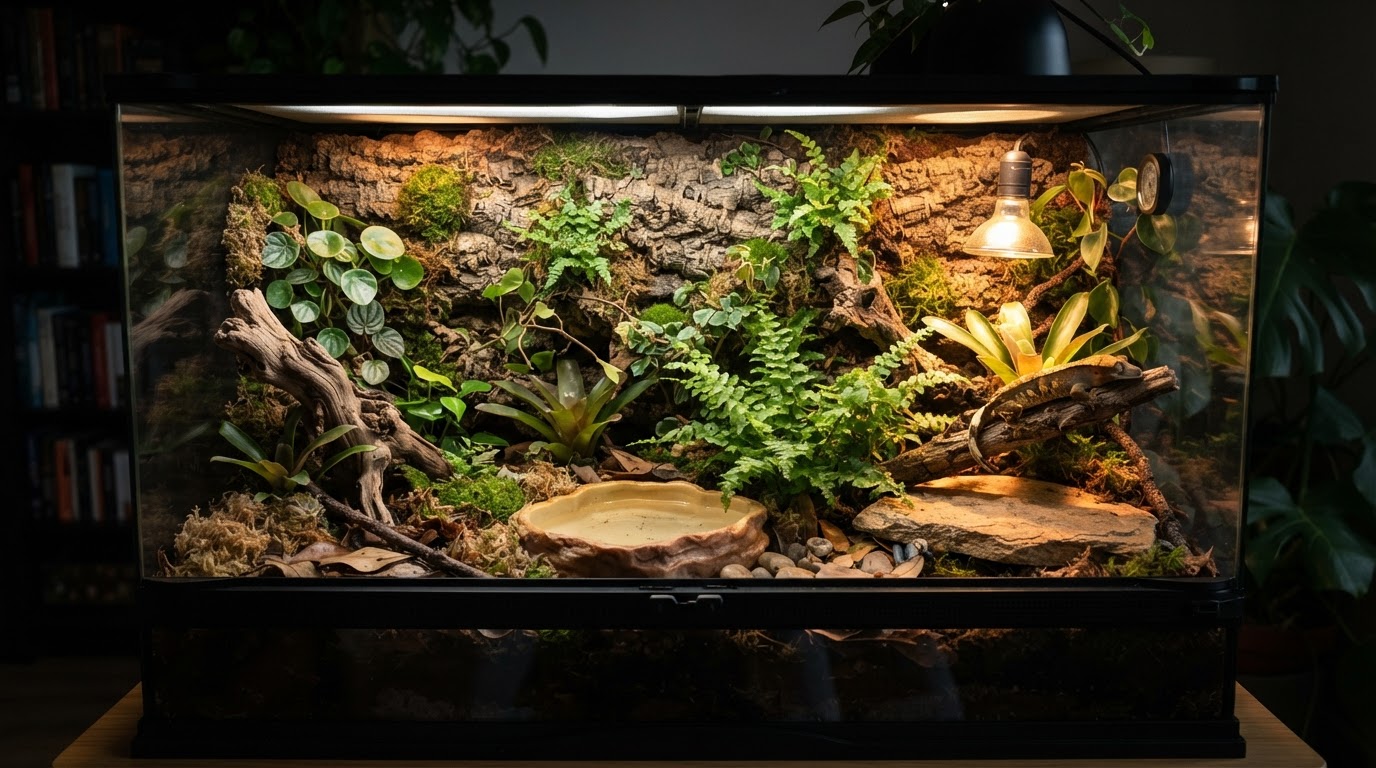
The Foundation of Reptile Care
Proper reptile care begins with understanding that these animals are fundamentally different from traditional pets. Dogs and cats are endotherms — they generate their own body heat and adapt readily to household conditions. Reptiles, as ectotherms, depend entirely on their environment for survival. Every aspect of their enclosure — temperature, humidity, lighting, and substrate — must be carefully calibrated to replicate their natural habitat.
The single most important principle in reptile husbandry is this: you're not just keeping an animal; you're maintaining an ecosystem. When that ecosystem is properly balanced, your reptile will thrive. When it isn't, health problems are inevitable, no matter how good the animal's genetics.
Choosing the Right Enclosure
The enclosure is your reptile's entire world, and choosing the right one is the first critical decision you'll make.
Size Matters
The common advice to "start small and upgrade later" is outdated and counterproductive. A young reptile placed in an appropriately sized adult enclosure will use the space — it won't be "stressed" by having room to explore. Starting with the correct final enclosure saves money and prevents the stress of repeated habitat changes.
General minimums:
- Leopard geckos: 40-gallon breeder tank (36" x 18" x 18")
- Bearded dragons: 120-gallon tank (48" x 24" x 24")
- Ball pythons: 4' x 2' x 2' PVC enclosure
- Corn snakes: 4' x 2' x 2' enclosure
- Red-eared sliders: 75-125 gallon aquatic setup
Enclosure Types
Glass terrariums offer excellent visibility and are widely available. However, they can struggle to maintain heat and humidity in dry climates. Screen tops allow heat and moisture to escape rapidly.
PVC enclosures are becoming the gold standard in reptile keeping. They hold heat and humidity far better than glass, are lightweight, easy to clean, and available in purpose-built sizes for specific species. Brands have made these increasingly affordable and attractive.
Wooden vivariums (often called "vivs") are popular in Europe and offer good insulation. They require sealing to prevent moisture damage and are heavier than PVC options.
Creating the Thermal Gradient
Every reptile enclosure must provide a thermal gradient — a range of temperatures from warm to cool that allows the animal to regulate its body temperature through behavioral thermoregulation.
The Warm Side
The warm side of the enclosure should include a basking spot — the hottest point in the habitat. Basking temperatures vary by species:
- Bearded dragons: 100-110°F
- Leopard geckos: 88-92°F
- Ball pythons: 88-92°F
- Corn snakes: 85-88°F
Heat sources include overhead ceramic heat emitters, radiant heat panels, deep heat projectors, and halogen basking lamps. Under-tank heating pads can supplement belly heat for ground-dwelling species but should never be the sole heat source for species that bask.
The Cool Side
The cool end of the enclosure should be 10-20°F cooler than the basking spot, providing a comfortable retreat. For most species, ambient room temperature (72-78°F) works well for the cool side.
Nighttime Temperatures
Most reptiles tolerate a nighttime temperature drop of 5-10°F, which mimics natural conditions. Temperatures should not drop below 65°F for most tropical species. If supplemental nighttime heat is needed, use a ceramic heat emitter or radiant heat panel — never a colored "night" bulb, as reptiles can see the light and it disrupts their sleep cycle.
Humidity Management
Humidity requirements vary dramatically between species and are one of the most commonly neglected aspects of reptile care.
Arid species (bearded dragons, leopard geckos, uromastyx) need ambient humidity of 30-40%, with a humid hide providing localized moisture for shedding.
Tropical species (crested geckos, ball pythons, chameleons) require 50-80% humidity, achieved through misting systems, larger water bowls, moisture-retaining substrates, and restricted ventilation.
Monitor humidity with a digital hygrometer placed at enclosure level — analog gauges are notoriously inaccurate. Excessively high humidity promotes respiratory infections and scale rot, while insufficient humidity causes dehydration and shedding complications.
Substrate Selection
Substrate — the material covering the enclosure floor — serves multiple functions: moisture retention, burrowing opportunities, waste absorption, and aesthetic appeal.
Bioactive substrates are increasingly popular and consist of a carefully layered system: a drainage layer, a substrate barrier, and a living soil mix inhabited by springtails and isopods that consume waste. When properly established, bioactive enclosures require minimal cleaning and create a naturalistic, enriching environment.
Loose substrates like topsoil/playsand mixes, cypress mulch, and coconut fiber are suitable for many species when kept at proper humidity. The risk of impaction from ingested substrate is real but often overstated — impaction typically results from inadequate temperatures or dehydration, not the substrate itself.
Non-particulate substrates like paper towels, reptile carpet, and slate tile are safe options for quarantine setups or species prone to ingesting substrate. They're easy to clean but provide limited enrichment.
Lighting: More Than Illumination
Proper lighting serves three critical functions for reptiles: providing a day/night cycle, generating heat (with appropriate bulbs), and producing UVB radiation for vitamin D3 synthesis.
UVB Lighting
Most diurnal reptiles require UVB lighting to synthesize vitamin D3, which is essential for calcium metabolism. Without adequate UVB, reptiles develop metabolic bone disease (MBD) — a painful, debilitating condition that causes softened bones, deformities, and eventual organ failure.
Linear fluorescent UVB tubes (T5 HO) are preferred over compact coil bulbs, as they provide more even UVB distribution across the enclosure. UVB output diminishes over time — replace bulbs every 6-12 months, even if they still produce visible light.
Photoperiod
Maintain a consistent day/night cycle of 12-14 hours of light followed by 10-12 hours of darkness. Use timers to ensure consistency. This cycle regulates circadian rhythms, appetite, activity levels, and reproductive behavior.
Feeding and Nutrition
Reptile diets fall into three broad categories:
Insectivores (leopard geckos, young bearded dragons) eat live insects. Crickets, dubia roaches, black soldier fly larvae, and silkworms are excellent staples. Always gut-load insects with nutritious food 24-48 hours before feeding, and dust them with calcium and vitamin D3 supplements.
Herbivores (adult bearded dragons, tortoises, iguanas) eat primarily plant matter. Dark leafy greens (collard greens, mustard greens, dandelion greens) should form the base of the diet. Avoid iceberg lettuce (nutritionally empty) and spinach (binds calcium).
Carnivores (snakes, monitors) eat whole prey. Frozen-thawed rodents are safer and more humane than live prey. Feed size should be approximately the same width as the widest part of the snake's body.
Cleaning and Maintenance
A consistent cleaning routine prevents bacterial growth, parasite buildup, and unpleasant odors.
Daily tasks: Spot-clean waste, refresh water dishes, check temperatures and humidity, observe your reptile's behavior and appearance.
Weekly tasks: Wipe down enclosure walls, clean and disinfect water dishes, replace soiled substrate patches, check all equipment (lights, heaters, thermostats) for proper function.
Monthly tasks: Deep clean the enclosure (for non-bioactive setups), inspect and replace worn equipment, check UVB bulb output if you have a UV meter.
Disinfection: Use a reptile-safe disinfectant or a solution of 1:10 chlorhexidine. Rinse thoroughly and allow to dry completely before reintroducing your reptile. Never use pine-based or phenol-based cleaners — they're toxic to reptiles.
Health Monitoring
Prevention is always better than treatment. Learn to recognize the signs of a healthy reptile:
- Clear, bright eyes (no swelling or discharge)
- Clean nostrils (no bubbling or mucus)
- Smooth, clean scales (no retained shed, discoloration, or lesions)
- Good body condition (not too thin, not obese)
- Regular, well-formed droppings
- Active, alert behavior during appropriate times
- Strong appetite at regular feeding intervals
- Complete, clean sheds
Any deviation from these norms warrants closer observation and potentially a veterinary visit. Find a reptile-experienced veterinarian before you need one — not all vets are trained in herptile medicine.
Common Beginner Mistakes
Avoiding these common pitfalls will give your reptile the best possible start:
- Inadequate research before purchase — Every species has unique needs. Research for weeks before buying.
- Wrong temperatures — Invest in quality thermostats and digital thermometers. Guessing kills reptiles.
- Skipping UVB — Even species that can technically survive without UVB benefit from it.
- Handling too soon — Give new reptiles 1-2 weeks to acclimate before handling.
- Ignoring humidity — This silent killer causes respiratory infections and shedding issues.
- Feeding only one food item — Variety prevents nutritional deficiencies.
- Using analog gauges — Digital thermometers and hygrometers are accurate; analog ones are not.
Reptile care is a rewarding practice that improves with experience. Start with a well-researched species, invest in quality equipment, and never stop learning. Your reptile is counting on you to be the best keeper you can be.
Frequently Asked Questions
What do reptiles need in their habitat?
Reptiles need a properly sized enclosure with a thermal gradient (warm basking side and cool retreat), appropriate humidity levels, UVB lighting for most diurnal species, suitable substrate, hiding spots, climbing structures (for arboreal species), clean water, and a consistent day/night cycle. The specifics vary by species.
How do I maintain proper humidity for my reptile?
Monitor humidity with a digital hygrometer. Increase humidity through misting, larger water bowls, moisture-retaining substrates (coconut fiber, sphagnum moss), or automated misting systems. Decrease humidity by increasing ventilation. Arid species need 30-40% ambient humidity; tropical species need 50-80%.
How often should I clean my reptile's enclosure?
Spot-clean waste daily, wipe surfaces and refresh water weekly, and perform deep cleans monthly (for non-bioactive setups). Use reptile-safe disinfectants and rinse thoroughly. Bioactive enclosures with cleanup crews (springtails, isopods) require less frequent deep cleaning.
What are the signs of a healthy reptile?
Healthy reptiles have clear bright eyes, clean nostrils without discharge, smooth scales without retained shed, good body condition (not too thin or obese), regular well-formed droppings, alert behavior during active hours, consistent appetite, and complete clean sheds.
How do I set up a suitable environment for my reptile?
Research your specific species' requirements first. Choose an appropriately sized enclosure, install heating equipment with a thermostat to create a thermal gradient, add UVB lighting on a timer, select suitable substrate, add hides and enrichment items, set up a water source, and verify all parameters with digital instruments before introducing your reptile.